
Theres no simple answer to that. Every person’s dementia journey looks different. Some people stay in the early stages for years, while others move through them faster than anyone expects.
But understanding the seven stages of dementia gives you a roadmap. It won’t predict the future, but it helps you prepare, plan and make smart decisions about care.
We break down each stage, explain how long it typically lasts and show you where live-in care fits into the picture. We also cover things most guides skip like how dementia type changes the timeline, what sundowning really means and when hospice care becomes relevant.
What Are the 7 Stages of Dementia?
The seven stages come from a tool called the Global Deterioration Scale (GDS). Dr Barry Reisberg at New York University developed it, and doctors around the world now use it to track how dementia progresses especially Alzheimer’s disease.
The scale divides the condition into seven stages, starting from zero symptoms and ending at very severe decline.
Here’s how it breaks down:
- Stages 1 to 3 are “pre-dementia” stages where symptoms stay mild or barely noticeable
- Stages 4 to 7 are the actual dementia stages where daily life becomes visibly affected
The GDS isn’t the only tool doctors rely on. Two other common ones include:
- FAST (Functional Assessment Staging Tool) — Dr Reisberg also created this one, and it focuses more on physical abilities and daily functioning
- CDR (Clinical Dementia Rating) — this evaluates six areas including memory, judgment and personal care through patient and family interviews
| Stage | Description | Typical Duration | Key Symptoms | Live-In Care Needed? |
|---|---|---|---|---|
| Stage 1 | No cognitive decline | N/A | None — brain changes may happen silently | No |
| Stage 2 | Very mild decline | Varies widely | Occasional forgetfulness, misplacing items | No |
| Stage 3 | Mild cognitive decline | 2–7 years | Word-finding trouble, losing valuables, planning issues | Not usually |
| Stage 4 | Moderate decline (early dementia) | About 2 years | Forgetting recent events, trouble with finances | Sometimes helpful |
| Stage 5 | Moderately severe decline (mid-stage) | About 1.5–2 years | Confusion about time and place, needs daily help | Often recommended |
| Stage 6 | Severe decline (late mid-stage) | About 2.5 years | Personality changes, incontinence, doesn’t recognise family | Strongly recommended |
| Stage 7 | Very severe decline (end-stage) | 1–3 years | Loss of speech, mobility and ability to swallow | Essential |
Note: These durations are averages based on Alzheimer’s progression. Individual experiences vary a lot.
No Cognitive Decline
At this stage, there are zero symptoms. The person functions normally, passes any cognitive test and shows no signs of memory problems.
Most people at this point have no clue anything is changing inside their brain. But research tells us that brain changes linked to Alzheimer’s can start decades before any visible symptoms show up.
Very Mild Cognitive Decline
This is where tiny hints start popping up. A person might:
- Forget where they put their keys more often than usual
- Struggle to recall a name they knew well before
- Lose their train of thought in the middle of a conversation
These lapses are easy to brush off as “just getting older.” Doctors typically can’t pick up any measurable decline at this point, and family members rarely notice anything unusual.
Some research suggests this stage can stretch up to 15 years in otherwise healthy people. For some, it never goes any further.
Live-in care at this stage: Not necessary. The person manages everything on their own.
Mild Cognitive Decline
Now the signs get clearer. Close friends and family start picking up on changes. Common symptoms include:
- Trouble finding the right words in conversations
- Forgetting something they just read
- Difficulty with planning and staying organised
- Losing valuable objects more often
- Slight problems with concentration
Doctors often call this stage “mild cognitive impairment” or MCI. Not everyone with MCI goes on to develop full dementia, but it’s a strong signal to pay attention.
Stage 3 typically lasts two to seven years. That often makes it the longest single stage in the entire dementia journey. This is the critical window for families to have honest conversations about future care preferences, legal matters and finances while the person can still take part in those decisions.
Live-in care at this stage: You probably don’t need it yet, but start researching care providers now so you’re not scrambling later.
Moderate Cognitive Decline Early-Stage Dementia
This is where doctors formally diagnose dementia. The symptoms are now clear enough to show up in clinical testing. You might notice your loved one:
- Forgetting recent events or conversations
- Struggling to manage finances or pay bills on time
- Having difficulty cooking meals that used to come easy
- Pulling away from social situations
- Getting confused about dates or the order of events
This stage usually lasts around two years. The person may still live somewhat independently, but they need more and more support with medications, appointments and money management.
Here’s the tough part many people at this stage know their abilities are slipping. That awareness often brings frustration, anxiety and sometimes depression. Emotional support matters just as much as practical help right now.
Live-in care at this stage: It can help a lot, especially if the person lives alone. A carer brings gentle supervision, household help and companionship.
Moderately Severe Decline Mid-Stage Dementia

This is a major turning point. The person can no longer live safely without help. They might:
- Not remember their home address or phone number
- Feel confused about the date, the season or where they are
- Struggle to pick out weather-appropriate clothing
- Need reminders and prompts for daily routines
- Still know their own name and recognise close family members
Stage 5 typically lasts one and a half to two years. Early on, the person might just need cues like clothes set out on the bed. But over time, they need more hands-on assistance.
This is when families face their hardest decisions. Can they stay home safely? Do you bring in outside help? Live-in care often turns out to be the ideal middle ground professional support without pulling the person out of their home.
Live-in care at this stage: Highly recommended. You can no longer leave your loved one on their own for long stretches. They need consistent supervision.
Severe Cognitive Decline Late Mid-Stage Dementia
Stage 6 brings big, visible changes. The symptoms hit hard:
- May not recognise family members anymore
- Mixes up the past with the present
- Forgets major life events
- Personality shifts agitation, suspicion, compulsive habits like hand-wringing
- Needs help with bathing, dressing and using the toilet
- Incontinence becomes common
- Sleep patterns flip sleeping by day, restless at night
This stage lasts an average of about two and a half years. For family caregivers, it’s often the most exhausting stretch of the whole journey.
In the U.S. alone, roughly 16 million people provide unpaid care to someone with dementia. A huge number of them hit their breaking point during Stage 6. That’s not a failure it’s reality.
Live-in care at this stage: Strongly recommended. A trained dementia carer handles the complex physical and emotional needs, manages difficult behaviours and gives families breathing room.
What Is Sundowning and When Does It Happen
Sundowning catches a lot of families off guard, so let’s talk about it properly.
It’s a pattern where a person with dementia gets more confused, agitated or restless once late afternoon and evening roll around. They might:
- Pace around the house nonstop
- Try to leave or wander outside
- Get suspicious of family members for no clear reason
- Refuse to settle down for the night
- Show sudden mood swings or bursts of anxiety
Sundowning typically shows up during Stage 5 or 6 and can carry on into Stage 7. Nobody knows the exact cause, but experts think it connects to changes in the brain’s internal clock, daily fatigue, dim lighting and overstimulation.
A trained live-in carer deals with sundowning by:
- Keeping the home well-lit through the evening
- Sticking to a calm, predictable daily routine
- Cutting back on caffeine and sugar after lunch
- Gently redirecting the person when agitation kicks in
Having someone around who understands sun downing and stays calm when it happens makes an enormous difference for the whole household.
Very Severe Cognitive Decline End-Stage Dementia
The final stage is the hardest to witness. The person becomes entirely dependent on others for everything:
- Speech drops to a handful of words, then disappears altogether
- They can no longer walk without someone holding them
- Eventually they can’t sit up or hold their head steady
- Swallowing gets difficult and dangerous
- They lose the ability to smile
- Organs begin to shut down
Dr Reisberg’s research breaks Stage 7 into substages. Each one from losing speech to losing the ability to hold the head up can last roughly a year or more.
Even now, the person may still respond to a gentle touch, a familiar voice or a piece of music they once loved. Some people even have brief “moments of lucidity” sudden flashes of awareness that feel both beautiful and heartbreaking.
Most people pass away during Stage 7. The most common causes include:
- Pneumonia this is the number one cause
- Infections from pressure sores
- Aspiration caused by swallowing difficulties
- General failure of the body’s systems
This stage typically lasts one to three years.
Live-in care at this stage: Absolutely essential. End-stage dementia requires around-the-clock hands-on care that focuses on comfort, dignity and quality of life.
How Dementia Type Affects the Timeline
Here’s something most guides don’t stress enough the type of dementia your loved one has dramatically changes how long they live and how quickly they decline.
The seven-stage model comes from Alzheimer’s research. Other types of dementia follow very different paths.
- Alzheimer’s Disease: This one progresses the slowest out of the major forms. Average life expectancy after diagnosis runs four to eight years, though some people live 15 to 20 years. The stages tend to unfold gradually and follow a somewhat predictable pattern.
- Vascular Dementia: Reduced blood flow to the brain causes this type usually from strokes or mini-strokes. It tends to move in a “step-like” pattern rather than a smooth decline. A person might stay stable for months, then drop suddenly after a vascular event. Average life expectancy sits around five years.
- Lewy Body Dementia: People with this type typically live five to eight years after diagnosis. It can bring hallucinations, movement problems that look like Parkinson’s and big swings in alertness from one day to the next. Falls and physical complications create extra risks.
- Frontotemporal Dementia: This type usually hits younger people often in their 50s or 60s and it attacks personality, behaviour and language before it touches memory. Life expectancy runs six to eight years. When it shows up alongside motor neurone disease, that window can shrink to just two or three years.
Palliative Care and Hospice for Late-Stage Dementia
Once dementia reaches Stage 6 and Stage 7, the focus of care shifts. You can’t cure the disease. The goal becomes keeping the person comfortable, pain-free and treated with dignity.
This is where palliative care and hospice step in and they work differently.
Palliative Care:
Palliative care can start at any stage of dementia. It focuses on improving daily life by managing symptoms:
- Pain relief
- Help with breathing difficulties
- Support for anxiety and agitation
- Guidance for families making tough calls
You don’t need to be near the end of life to benefit from palliative care.
Hospice Care:
Hospice is specifically for people approaching the end of life usually when a doctor estimates six months or less remain. For someone with dementia, that typically means deep into Stage 7.
Hospice provides:
- Specialised medical support focused on comfort
- Pain and symptom management
- Emotional and spiritual support for the patient and family
- Care that prioritises peace over treatment
Here’s the good news hospice can happen at home. That makes it a natural partner for live-in care. Your live-in carer handles the personal day-to-day needs while the hospice team brings in medical expertise and counselling.
Don’t wait for a crisis before you ask about these options. Having the conversation early takes enormous pressure off when the time arrives.
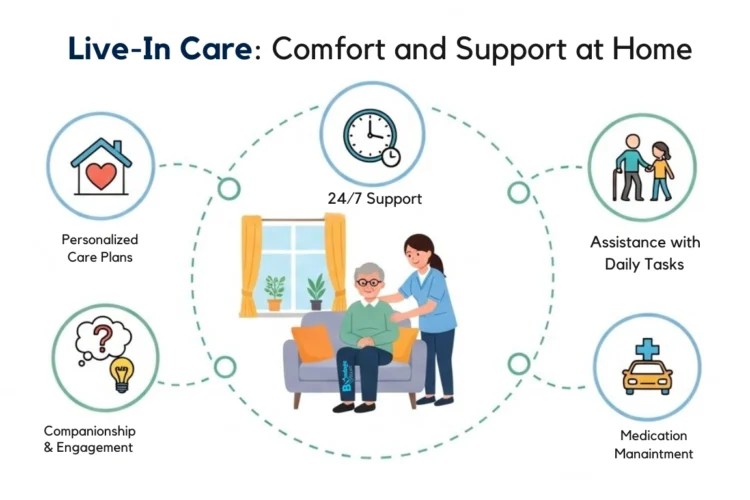
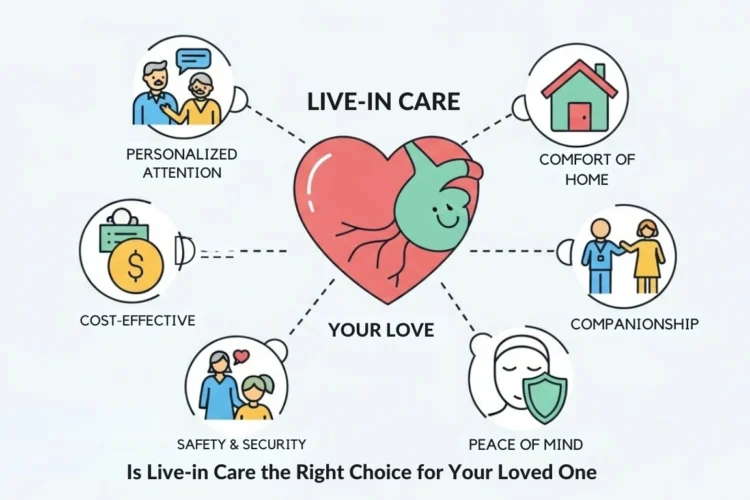
Why Live-In Care Makes a Real Difference for Dementia

Why do so many families pick live-in care over a care home? Several strong reasons keep coming up.
- Familiar Surroundings Cut Down Confusion: Home is an anchor for someone with dementia. The familiar rooms, the garden, their favourite chair all of it brings comfort and eases anxiety. Moving to a new environment during the middle or later stages can trigger a sharp decline. Live-in care takes that risk off the table completely.
- One-to-One Attention You Can’t Get Elsewhere: In most care homes, one carer looks after about four residents at the same time. With live-in care, your loved one gets dedicated attention from someone who learns their habits, preferences and personality inside out.
- Routine Brings Security: People with dementia thrive on predictable routines. Breakfast at 8, a walk at 10, lunch at 12 that kind of rhythm provides security and fights back against confusion. A live-in carer keeps those patterns steady and introduces changes gently when they need to.
- Your Family Stays at the Centre: No visiting hours. No rigid schedules. You pop in whenever you want, share meals together and stay closely involved in your loved one’s everyday life.
- Couples Don’t Have to Separate: Live-in care lets elderly couples stay together in their own home. In care homes, couples sometimes end up in different rooms or different wings. Staying together protects the relationship and supports emotional wellbeing for both people.
- The Cost Might Surprise You: Many families assume live-in care costs far more than a care home. In reality, the two are often comparable and for couples, live-in care frequently works out cheaper because a care home charges per person while one carer supports both partners under the same roof.
When Should You Start Thinking About Live-In Care?
Earlier than you’d expect. Most families hold off until something goes wrong a fall, a wandering scare, a trip to A&E before they look into professional help.
Start your research during Stage 3 or early Stage 4. You don’t need to hire anyone right away, but knowing what’s out there removes a huge amount of pressure later.
Here are clear signs it’s time to take the next step:
- The person can’t safely stay on their own anymore
- Personal hygiene is slipping
- Wandering or getting lost has become a genuine risk
- Family caregivers are burning out
- The person’s needs have grown beyond what family can handle
By Stage 5, most families find that daily support becomes a necessity rather than an option.
What Affects How Fast Dementia Progresses
The timelines in this guide are averages. Several things can speed up or slow down the journey.
- Type of Dementia: Alzheimer’s moves slower than vascular or Lewy body dementia. This single factor has the biggest impact on how fast someone declines.
- Age at Diagnosis: People who get diagnosed younger may live longer overall, but younger-onset dementia can sometimes hit harder and faster. Those diagnosed after 90 tend to have shorter life expectancies because of other health conditions piling up.
- Gender: Women with dementia live about a year and a half longer than men on average. Researchers think this comes down to a mix of genetics, lifestyle habits and general health differences.
- Physical Health: Diabetes, heart disease and high blood pressure all speed dementia along. Keeping these conditions under control with help from a live-in carer who stays on top of medications and healthy meals can genuinely slow things down.
- Social Connection and Mental Activity: Staying active, eating well, spending time with other people and keeping the brain engaged won’t stop dementia. But research consistently shows these habits slow progression and improve quality of life at every stage.
- Quality of Care: This is the one thing families can control most directly. Good medical care, a stable home environment, proper nutrition and compassionate daily support all help a person live better and sometimes longer with dementia.
Final Thoughts
Dementia is a long, unpredictable road but you don’t have to walk it blindly. Knowing what each stage looks like, roughly how long it lasts and what kind of care fits best at each point puts you in a much stronger position to make smart, compassionate decisions. Live-in care won’t change the diagnosis, but it can change the whole experience keeping your loved one safe, comfortable and surrounded by everything familiar while giving your family the support and peace of mind you all deserve.